
Companies in the United Kingdom that file a Corporation Tax return (CT600) are required by HMRC to follow prescribed digital reporting guidelines. This involves submitting iXBRL-tagged statutory accounts and tax computations via the HMRC’s online portal.
As HMRC strengthens its validation procedures and digital inspections, errors in tagging, taxonomy mapping, or computation alignment can result in rejected submissions and delayed files.
This guide explains:
- What HMRC requires for CT600 filing
- Where companies commonly fail validation
- How to reduce iXBRL compliance risk
What Is Required for HMRC CT600 Filing?
All UK limited companies subject to Corporation Tax must file their return electronically via HMRC’s portal.
Core HMRC Filing Components
Filing Component | Mandatory? | Format | Key Compliance Risk |
Statutory Accounts | Yes | iXBRL | Incorrect FRS 101 / FRS 102 / IFRS taxonomy selection |
CT600 Tax Return | Yes | HMRC Online | Data misalignment with computations |
Tax Computation | Yes | iXBRL | Incomplete tagging or validation errors |
HMRC Gateway Validation | Yes | Automated check | Technical rejection before acceptance |
Failure during HMRC gateway validation often stems from tagging inconsistencies or formatting issues, not necessarily tax errors.
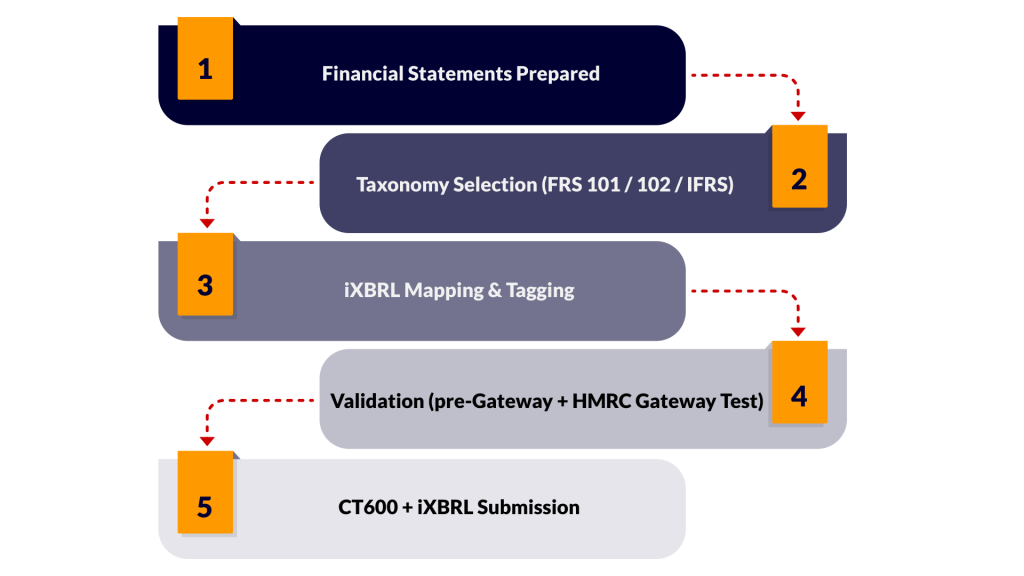
HMRC iXBRL Tagging Workflow (How the Process Should Work)
The following is a recommended end-to-end iXBRL and CT600 submission workflow for compliance filing.
Common Reasons HMRC CT600 Filings Are Rejected
Common Issue | Root Cause | Impact on Filing |
Taxonomy Misapplication | Incorrect GAAP framework used | Immediate validation rejection |
Incomplete Tagging | Manual mapping gaps | HMRC gateway failure |
Late Validation Testing | No pre-submission check | Missed filing deadline |
Peak Season Overload | Limited internal bandwidth | Higher outsourcing costs |
Even experienced finance teams encounter recurring issues.
As HMRC’s reliance on structured digital filings grows, tagging depth and validation accuracy are under more scrutiny, particularly for medium and large UK businesses.
Why HMRC iXBRL Compliance Is Becoming More Complex
Several regulatory and operational variables increase compliance pressure:
- Digital-first tax administration
- Increased cross-checking between accounts and CT600
- Expanded disclosure requirements under UK GAAP
- Greater data consistency expectations
Companies that rely solely on manual Excel procedures frequently encounter increased error rates and multiple gateway rejections.
How DataTracks Helps CT600 Filers
CT600 filing is more than just submission for UK businesses and accounting firms; it is also about accuracy, speed, and risk management.
DataTracks supports HMRC filers with:
- Secure portal upload of Word, Excel, or PDF accounts
- Complete iXBRL labeling of statutory accounts and tax computations.
- Validation against HMRC gateway rules before submission
- Assistance in preparing and filing CT600 forms.
- Amendment support until successful acceptance.
- Standard and expedited turnaround options.
Conclusion: Preparing for the Next CT600 Filing Cycle
HMRC iXBRL filing is no longer a mechanical compliance task. It is a structured data submission governed by validation rules and technical precision.
Companies that invest in:
- Proper taxonomy selection
- Robust validation workflows
- Scalable tagging support
will significantly reduce filing risk and internal strain.
As filing windows tighten and compliance complexity increases, CT600 preparation should not fail and must shift from reactive correction to proactive validation.
With growing scrutiny of digital compliance, many medium and big UK businesses seek specialist providers to decrease rejection risk and filing pressure.
The goal is simple:
Submit once. Get accepted. Avoid making revisions.