What Happens After Your ACRA XBRL Filing
BEYOND THE FILING: HOW DIGITAL REPORTING REALLY WORKS
What Happens to Your ACRA XBRL Data After You File It?
For issuers and senior finance professionals
For many issuers and finance teams, an XBRL filing feels like the end of the job.
The financial statements are finalised. The data is mapped. The file passes validation. The annual return proceeds. The reporting project is closed.
But from a digital reporting perspective, submission is not the end of the process. It is the point at which the information begins a different life.
Once an ACRA XBRL filing has been submitted, the data is no longer only a document prepared for directors, members, auditors or internal reviewers. It becomes structured information that can be stored, accessed, extracted, compared and analysed in ways that are very different from reading a PDF or printed financial statement.
That is why finance teams should care not only about getting the filing out, but also about how the data will be consumed after it leaves their hands.
Filing Is A Handover, Not A Finish Line
The traditional way of thinking about statutory reporting is document-based.
A company prepares a set of financial statements. People read it in full. The meaning is carried by the layout, the line-item labels, the notes and the professional judgement of the reader.
XBRL changes that model.
In an XBRL environment, the filing still reflects the financial statements, but it also creates a structured representation of the information. Each reported fact is linked to a taxonomy concept and combined with additional context such as the reporting entity, the reporting period, the currency or unit, and any relevant dimensional breakdown.
That means the information can be used outside the original document layout.
From the company’s perspective, filing can feel like submission to a portal. In reality, it is also a handover into a digital reporting system.
That distinction matters. A document prepared for reading and a dataset prepared for processing are not the same thing, even when they originate from the same financial statements.
How A Financial Statement Becomes Structured Data
To understand what happens after filing, it helps to understand what has been created.
A traditional financial statement tells a story through presentation. A revenue figure appears in a particular statement, under a particular heading, within a specific set of disclosures.
An XBRL filing expresses that same information in a machine-readable form.
- a reported value
- a taxonomy concept
- the reporting entity
- the reporting period
- the unit or currency
- any applicable dimensions or classifications
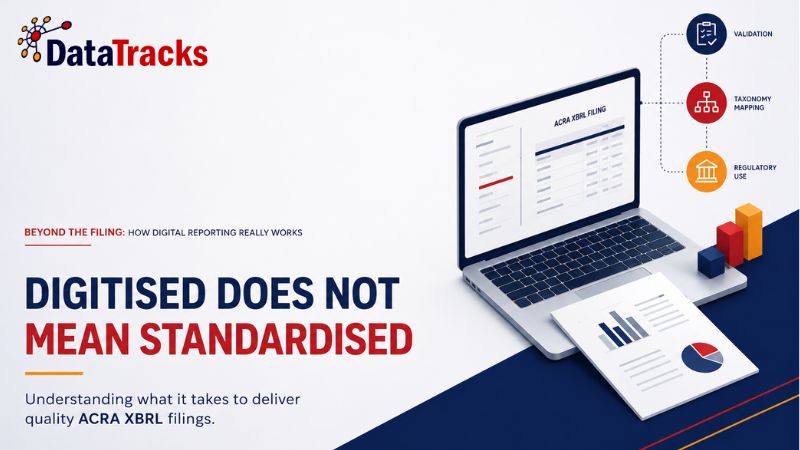
This combination is what makes XBRL different from a digitised document.
A spreadsheet is digital. A PDF is digital. But their meaning still depends heavily on human reading. XBRL captures not only the number, but also its defined identity.
That identity is what allows the data to be processed more consistently after filing.
In other words, once the financial statements have been converted into structured data, the information is no longer tied only to how it looked on the page. It can now be handled as a dataset.
What Can Happen To The Data After Submission
The exact post-filing workflow differs by reporting system and jurisdiction. But conceptually, once an XBRL filing Singapore process is completed, the data can move through several stages.
1. Validation and acceptance
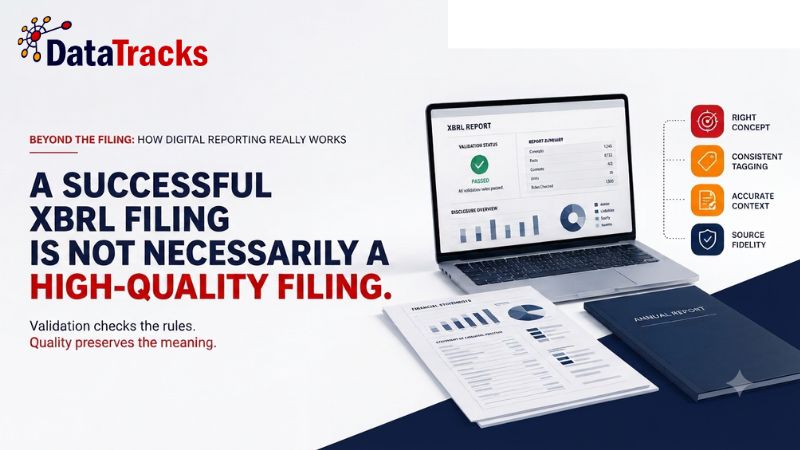
Before or during filing, the system checks whether the XBRL report meets the relevant technical and business rules. This is the quality gate most preparers are familiar with.
But acceptance is only the first downstream step.
2. Storage and preservation
The filed report and its structured contents can be retained as part of the company’s reporting record for that period.
In a structured environment, the system is not only preserving a final document. It is also preserving machine-readable facts associated with the filing.
That makes later retrieval, comparison or re-use much easier than relying only on unstructured documents.
3. Access and publication
ACRA states that financial statements filed as part of annual returns are available for public purchase. That means the filing does not remain purely internal to the submission process.
This point is often underestimated by preparers. Once filed, the information can become part of a broader information environment in which others may access the company’s financial statements and interpret the data.
4. Extraction and analysis
This is where the importance of XBRL quality becomes much clearer.
Because each reported fact has a defined structure, the data can potentially be used for:
- period-to-period comparison
- peer comparison
- ratio and trend analysis
- screening and benchmarking
- dataset building
- automated research workflows
- identifying unusual movements or outliers
The important point is not to speculate about every specific analytical use by every stakeholder. The point is that XBRL makes these uses technically possible and far easier than a system based only on PDFs.
And that changes what good preparation looks like.
The Report People Read And The Data Systems See Are Not Always The Same
This is the core issue senior finance professionals should understand.
Suppose a company includes a line item called Platform and technology operating expenses.
A human reader can interpret that disclosure using the surrounding context in the financial statements. They can review the notes. They can understand the company’s business model. They can make sense of the label in context.
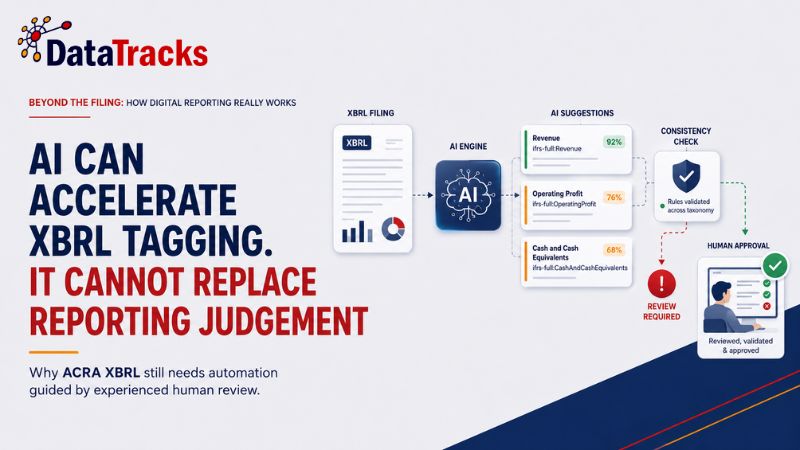
But when that same figure is filed in XBRL, it must be represented through a selected taxonomy concept.
If it is mapped to a precise operating expense concept, the data may travel downstream in a useful way.
If it is mapped to a broad “other expenses” concept, the number may still be correct in value, but it may become less informative once extracted.
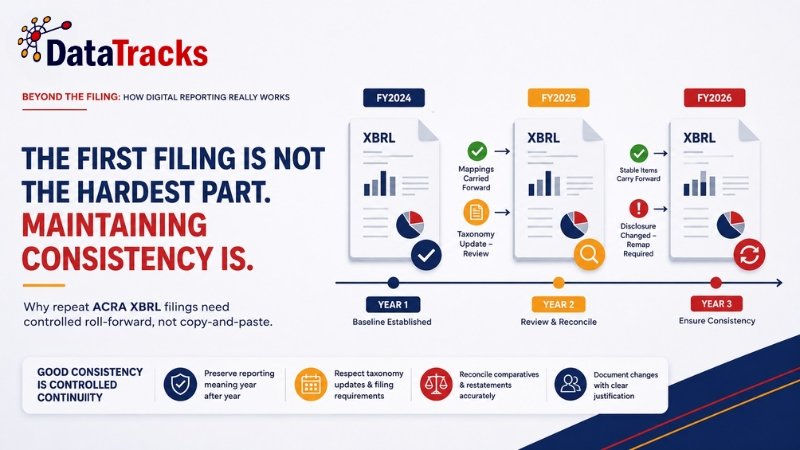
If the same concept is not used consistently next year, the company’s own digital reporting trail becomes less stable.
The printed financial statement has not changed.
But the analytical identity of the data has.
That is why preparers should not evaluate an XBRL conversion service only by whether it produced an accepted file. They should also consider whether the structured output remains meaningful when used outside the visual report.
Why Preparers Should Care About Downstream Consumption
Some finance teams see downstream use as someone else’s concern. Once the filing is accepted, the job is done.
That view is too narrow.
The way data is tagged today can influence how the company is represented tomorrow. Poor downstream structure may not create an immediate filing failure, but it can create longer-term weaknesses.
- fragmented year-on-year comparability
- overuse of broad concepts that reduce analytical usefulness
- incorrect or weak context attached to otherwise correct values
- inconsistent treatment across entities, periods or disclosures
- difficulty reproducing prior-year decisions
- greater dependence on the memory of individual preparers
- a weaker digital record of the company’s reporting history
This matters especially for issuers and senior finance professionals because digital reporting is cumulative. One filing does not stand alone. It becomes part of a continuing data history.
A finance team may review the rendered filing and conclude that everything looks right. But if the extracted-data view tells a different story, the filing has only partially succeeded.
The Datatracks Point Of View: Prepare For The Extracted View
This is where the mindset needs to shift.
Most preparers review the filing as a document. Fewer review it as a dataset.
But the extracted view is exactly what gives XBRL its long-term value.
DataTracks’ perspective is that an effective ACRA XBRL filing should be reviewed in two ways:
- The rendered view — how the filing appears as a report
- The extracted view — how the facts are likely to appear when pulled into a structured-data environment
That second view leads to better questions:
- What will this fact be called when extracted?
- What period and entity will it be associated with?
- Is the selected concept the best representation of the disclosure’s meaning?
- Will the same treatment hold up in the next reporting cycle?
- Would a third party comparing companies interpret this classification correctly?
This is not an academic exercise. It is a practical way to preserve meaning after submission.
The filing portal is only one audience. The downstream data environment is another.
Six Ways To Prepare XBRL Data For Downstream Use
1. Review concept meaning, not only concept labels
Choose taxonomy concepts based on accounting meaning, not just wording similarity.
2. Check consistency across reporting periods
Compare the concepts used this year with those used previously, especially for recurring disclosures.
3. Verify context as carefully as values
Review the entity, period, unit and any dimensional context attached to each important fact.
4. Limit broad “other” classifications
Use them cautiously and only when a more precise concept is not suitable.
5. Maintain a mapping record
Document judgement-based tagging decisions so they can be understood and repeated appropriately.
6. Review the filing beyond presentation
Do not ask only whether the filing looks right. Ask whether the structured data would still make sense when extracted and compared.
Submission Completes The Filing, Not The Life Of The Data
An accepted filing is a compliance milestone. It is not the end of the information journey.
Once submitted, ACRA XBRL data may be stored, accessed, extracted, compared and reused in ways that the original reporting team does not fully control. That is precisely why tagging quality, contextual accuracy and consistency matter so much.
For issuers and senior finance professionals, the practical lesson is simple: prepare the filing with the downstream user in mind.
A strong XBRL process does more than meet the filing requirement. It creates a structured representation of the company’s financial information that remains useful, reliable and defensible after submission.
That is what turns a filing exercise into a digital reporting discipline.