AI Can Accelerate ACRA XBRL Tagging
BEYOND THE FILING: HOW DIGITAL REPORTING REALLY WORKS
AI Can Accelerate ACRA XBRL Tagging. It Cannot Replace Reporting Judgement
Why automation must remain guided by taxonomy expertise, accounting judgement and accountable human review.
An AI-enabled reporting platform can analyse a set of financial statements, identify reportable facts and recommend taxonomy concepts within minutes.
For finance teams facing tight reporting deadlines, that is a meaningful improvement. Work that previously required extensive manual review can be completed faster, repeated mappings can be recognised automatically, and unusual disclosures can be brought to a reviewer’s attention.
But a faster recommendation is not the same as a correct reporting decision.
For an ACRA XBRL filing, every tagged fact must still represent the accounting meaning of the source financial statements within ACRA’s defined taxonomy and filing requirements. AI can support that process. It cannot take ownership of the judgement behind it.
What AI can genuinely improve in XBRL preparation
XBRL preparation includes several activities that are well suited to automation.
- Extracting potential facts from financial statements
- Recommending taxonomy concepts based on similar disclosures
- Recognising recurring mappings from earlier reporting periods
- Identifying disclosures that may not have been tagged
- Flagging inconsistent concept use within the same filing
- Highlighting differences between current-year and prior-year treatment
- Directing human attention towards unusual or low-confidence items
These capabilities can reduce repetitive work and allow experienced reviewers to spend more time on areas where interpretation is required.
XBRL International has described AI as a useful tagging “co-pilot”: it can improve speed, support error detection and strengthen consistency, but human oversight remains necessary where the disclosure is complex or company-specific.
The value of AI is not that it removes expertise from the filing process. Its value is that it can help apply that expertise more efficiently.
Why XBRL tagging is not only a pattern-matching exercise
A taxonomy concept cannot be selected solely because its label resembles the wording used in the financial statements.
ACRA defines taxonomy mapping as matching the line items in the company’s financial statements to relevant concepts in the ACRA taxonomy. It advises companies to involve an officer familiar with the financial statements and to review the mapping before submission. The taxonomy is closed, meaning preparers cannot create company-specific concepts when an exact wording match is unavailable.
This means a tagging decision may depend on:
- The accounting substance of the disclosure
- Whether the fact represents a point in time or a period
- Whether it relates to the group or the company
- The applicable currency or unit
- Whether several line items should be aggregated
- Whether one line item should be split across several concepts
- Whether the selected concept is the best available fit
- Whether the treatment remains consistent with prior periods
An AI model may recognise that a disclosure resembles items it has encountered before. But similarity is not necessarily equivalence.
Consider a line item described as “technology platform and support costs”. Depending on the underlying expenditure, it might relate to administrative costs, outsourced services, employee expenses, operating costs or another category.
An AI system may recommend a statistically plausible concept. A reviewer must decide whether that concept reflects what the amount actually represents.
AI confidence is not reporting certainty
AI systems operate by recognising patterns and predicting likely outputs.
That makes them valuable for recommendation and triage. It also creates a limitation: a high-confidence output is still a prediction.
The same disclosure wording can represent different accounting treatments in different companies. Conversely, two disclosures with different labels can represent substantially the same economic concept.
XBRL works differently. Taxonomy concepts, contexts, units and validation rules provide an explicit structure that software can process consistently. AI can help select and review those components, but it does not make the reporting framework itself optional.
AI proposes. The taxonomy constrains. Reporting professionals decide. Management remains accountable.
Five areas where human judgement remains essential
1. Interpreting accounting meaning
A reviewer must understand the underlying disclosure, not merely its wording. The source financial statements, relevant notes and accounting treatment may provide context that is not captured by a single line-item label.
2. Selecting the best-fit taxonomy concept
ACRA instructs preparers to use a best-fit principle and to place items under “others” only when they cannot be mapped to an available taxonomy concept. This selection can require accounting knowledge and judgement rather than simple text matching.
3. Evaluating changes from previous periods
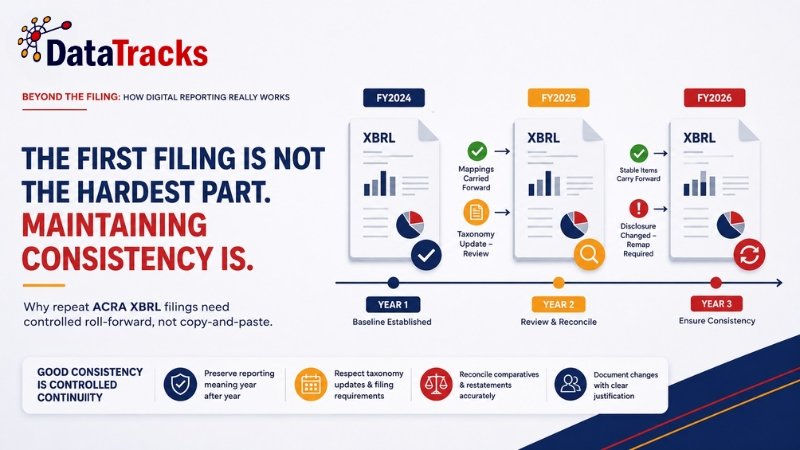
A different tag from the prior year may represent an error. It may also reflect a genuine change in the disclosure, business activity, accounting policy or taxonomy. AI can highlight the difference. It cannot automatically determine whether the difference is justified.
4. Reviewing context and reporting scope
A correct concept can still produce incorrect data when attached to the wrong period, currency, unit or entity scope.
5. Accepting responsibility for the filing
The reporting organisation remains responsible for the submitted information. AI does not change that accountability.
The governance risk: automation can hide judgement
The greatest risk in AI-assisted XBRL preparation is not necessarily an incorrect recommendation. It is an unreviewed recommendation.
Automation becomes risky when:
- Users accept suggestions without understanding the underlying taxonomy
- Confidence scores are treated as proof of correctness
- The rationale for a selected concept is not documented
- Human overrides are not retained
- Historically inconsistent filings are used as unquestioned precedents
- Taxonomy changes are not incorporated into the AI workflow
- Reviewers examine only low-confidence recommendations and assume high-confidence outputs are correct
- No individual has clear responsibility for final approval
The objective should not be to remove people from the reporting process. It should be to focus their attention on the decisions where judgement has the greatest effect.
A well-designed workflow uses automation to reduce repetitive effort while making material decisions easier to inspect.
The DataTracks point of view: design automation around reviewability
The strongest XBRL operating model is not manual preparation versus automated preparation. It is a controlled sequence:
Automated first pass | Taxonomy and rule validation | Experienced review | Accountable approval |
In this model, AI performs the work it is best suited to: identifying patterns, proposing likely mappings, surfacing exceptions, comparing treatments and prioritising review.
Experienced reporting professionals then evaluate the recommendation against the source disclosure, the ACRA taxonomy, the applicable filing guidance, the company’s accounting treatment, prior-period consistency and the complete reporting context.
A credible AI-assisted process should preserve a clear decision trail containing:
- The original disclosure
- The recommended taxonomy concept
- Alternative concepts considered where relevant
- The final selected concept
- Any human override
- The rationale for a judgement-based decision
- The reviewer responsible
- The applicable validation result
This does not slow automation down. It makes automation safe to rely on.
Six controls for responsible AI-assisted XBRL preparation
1. Treat AI outputs as recommendations
No suggested concept should become final merely because the system produced it with high confidence.
2. Apply taxonomy and filing rules independently
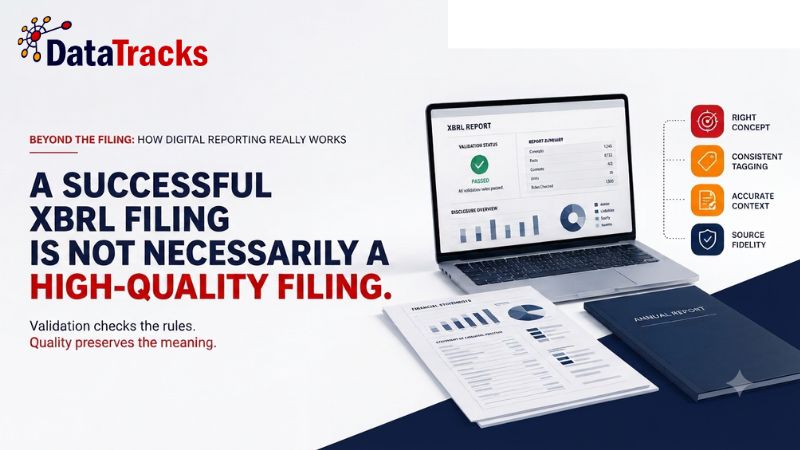
AI recommendations should still be tested against the applicable ACRA taxonomy and validation rules.
3. Escalate judgement-heavy items
Unusual disclosures, broad concepts, aggregations, changes from prior periods and low-confidence recommendations should receive experienced review.
4. Compare with prior periods without copying blindly
Historical mapping is useful evidence, not automatic authority.
5. Document material overrides
Where a reviewer rejects an AI recommendation, the final treatment and rationale should be retained for future filings.
6. Assign final accountability
A named reviewer familiar with both the financial statements and the taxonomy should approve the structured output before submission.
AI should reduce effort, not responsibility
AI can materially improve the speed of ACRA XBRL preparation. It can reduce repetitive tagging work, identify inconsistencies and help reporting teams focus on the most difficult disclosures.
But the purpose of XBRL is not simply to create tags quickly.
It is to preserve the accounting meaning of financial information within a standardised, machine-readable framework.
That requires taxonomy knowledge, contextual understanding and reporting judgement. It also requires someone to take responsibility for the final output.
The strongest XBRL conversion service therefore combines automation with experienced human review. AI proposes. The taxonomy constrains. Reporting professionals decide. Management remains accountable.
That is not a limitation of AI-assisted reporting. It is the governance model that makes it credible.