ACRA XBRL Filing
Beyond the Filing: How Digital Reporting Really Works
ACRA XBRL Filing: Why Digitised Financial Statements Are Not Yet Standardised Data
A digital financial statement is not automatically standardised. The real work begins when financial meaning must be translated into ACRA’s structured reporting framework.
A Digital Document Is Not The Same As Standardized Data
A finance team may complete its financial statements in Excel, circulate them electronically, approve them through a digital workflow and store them in the cloud. The report is unquestionably digital.
But that does not mean the information inside it is standardised.
This distinction matters when the same financial statements must be prepared for ACRA XBRL filing. Moving numbers from paper into a spreadsheet changes the medium. Standardising those numbers requires something more demanding: each reported fact must be mapped to a defined concept, placed in the correct reporting context and structured so that another system can interpret it consistently.
That is the real purpose of XBRL.
The Misconception: A Digital Document Is Structured Data
Many organisations use the words “digital” and “standardised” as though they mean the same thing. They do not.
A PDF, Word document or spreadsheet can be created, reviewed and transmitted electronically. Yet the financial information may still depend heavily on headings, layouts and internal naming conventions that only a human reader can interpret.
Consider a line item described as “other operating costs”, “administrative and operating expenses”, “general expenses” or “other overheads”. A finance professional may understand what each description means within the context of the company’s accounts. A computer cannot safely assume that they represent the same accounting concept.
Standardisation addresses this problem by connecting each reported item to a consistently defined taxonomy concept. It also adds the information required to interpret the fact correctly: the reporting entity, financial period, unit, dimensional breakdown and other relevant context.
XBRL International’s Regulatory Playbook draws the same distinction: digitisation changes a process through technology, while standardisation makes information consistent and interpretable across sources and systems. Without standardisation, digitalisation can simply produce more information that remains difficult to compare or reuse.
How ACRA XBRL Turns A Document Into Standardized Information
The process begins with the financial statements authorised by the company’s directors. These become the source from which the XBRL financial statements are prepared. The important work is not simply transferring values into a new file. It is interpreting the financial statements through the structure defined by the applicable ACRA taxonomy and filing rules.
Taxonomy mapping
The taxonomy acts as the reporting dictionary. It defines the concepts available for reporting and the relationships between them. The preparer must determine which concept most accurately represents each disclosure in the source financial statements.
This requires judgement. The wording used in the financial statements may not match the taxonomy label exactly. Mapping based only on similar words can produce an incorrect result. The preparer must consider the accounting meaning, the statement in which the item appears and the surrounding disclosures.
Facts need context, not just tags
A number on its own is not meaningful structured data. A value of S$2.5 million could represent revenue for the year, cash at the reporting date, expenditure for a segment or a comparative-period balance. The XBRL fact must carry the correct context so that a receiving system knows precisely what the number represents.
- The reporting period and whether the fact is measured at an instant or over a duration
- The reporting entity
- The currency or other unit of measure
- The applicable dimensional breakdown
- The level of rounding or accuracy
This combination of a reported value and its metadata is what allows the information to be interpreted consistently rather than merely displayed.
Validation
Once the mapping and data entry are complete, the XBRL file is validated against technical and business rules. Validation can identify structural problems, missing information, inconsistent calculations and breaches of defined requirements.
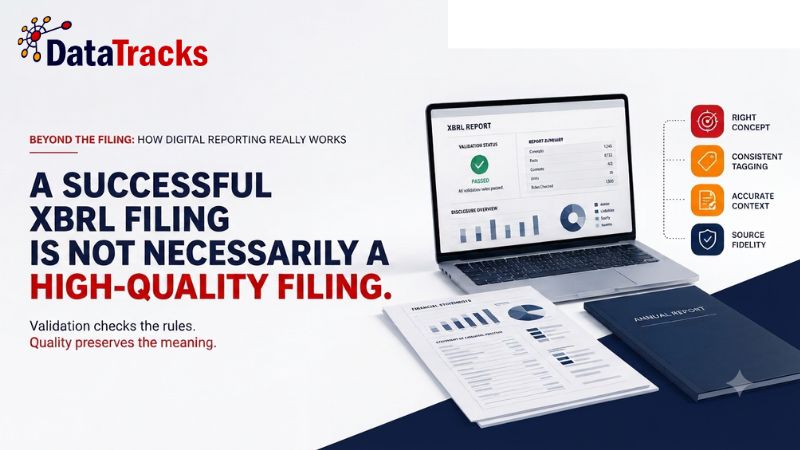
Its role must nevertheless be understood correctly. Validation cannot independently determine whether every selected taxonomy concept reflects management’s intended accounting meaning. A technically valid filing can therefore still contain weak mapping decisions.
ACRA XBRL Filing Is Part Of A Larger Data Lifecycle
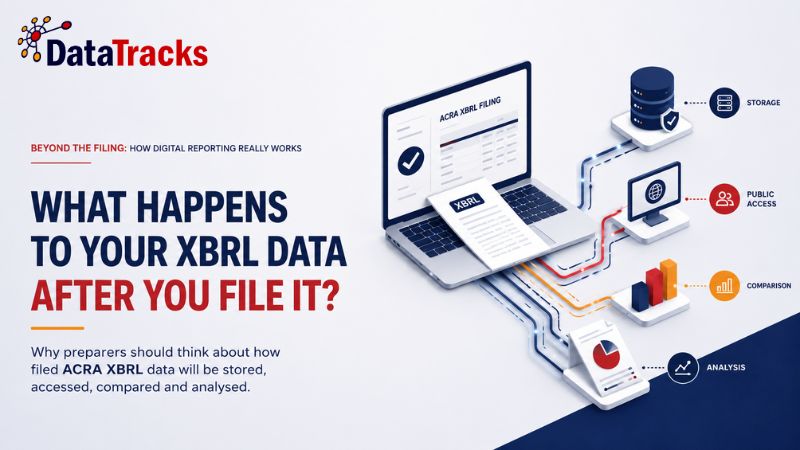
From the preparer’s perspective, successful upload can feel like the end of the process. From the regulator’s perspective, it is closer to the beginning.
Structured information can be validated, stored, rendered and used for analysis. It can also support comparisons across companies and reporting periods in ways that a static document cannot.
This changes how filing quality should be evaluated. A PDF may communicate the financial position effectively to a reader examining one company. Standardised XBRL data is intended to support processing and comparison across many entities and periods.
An incorrect taxonomy mapping may not change the number visible in the source financial statements. But it can change how that number is classified, extracted and compared downstream.
- Inconsistent year-on-year datasets
- Reduced comparability between companies
- Misleading analytical classifications
- Rework during subsequent filings
- Dependence on individuals who remember past mapping decisions
- Weak documentation for internal review or handover
The value of an XBRL conversion service should therefore not be judged solely by whether it produces an uploadable file. It should also be judged by whether the resulting data accurately represents the source disclosure and remains defensible when reviewed in later reporting periods.
The DataTracks Point Of View: Quality Starts With Intended Meaning
The most important question in an ACRA XBRL project is not: “Which tag looks closest to this line item?” It is: “What does this disclosure mean, and how should that meaning be represented within ACRA’s reporting structure?”
That difference separates document conversion from digital reporting.
A sound filing process should preserve a clear chain from the authorised financial statements to the selected taxonomy concept, the reporting context, the validation result and the final submission.
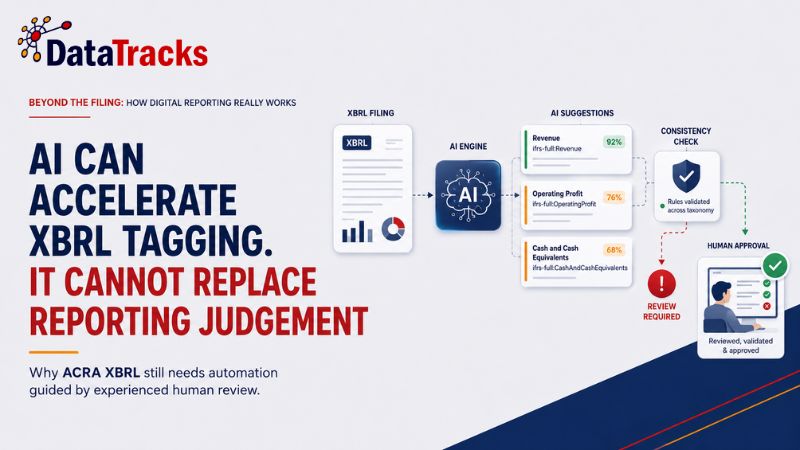
Automation can assist with data population, repeated mappings and validation. But it should not conceal the reasoning behind reporting decisions. Where the taxonomy does not mirror the company’s presentation exactly, accounting interpretation and documented review become more – not less – important.
DataTracks’ view is that filing quality should be assessed from three perspectives:
Source fidelity Does the XBRL file faithfully reflect the authorised financial statements? | Structural compliance Does it meet the applicable taxonomy and filing rules? | Data usability Will the information be interpreted consistently when extracted and compared? |
A file that satisfies only the second test may be technically acceptable but operationally weak.
Five Controls That Improve ACRA XBRL Filing Quality
1. Determine the applicable filing requirement first
Confirm the applicable XBRL scope and template before preparation begins. A wrong assumption at this stage creates avoidable rework later.
2. Review taxonomy mapping before bulk population
Resolve judgement-heavy line items first. Do not allow a large volume of populated data to create false confidence in mappings that have not been reviewed for accounting meaning.
3. Separate validation from mapping review
Treat technical validation as one control, not the entire quality-assurance process. Conduct a separate review of whether concepts, periods, units and breakdowns accurately represent the source financial statements.
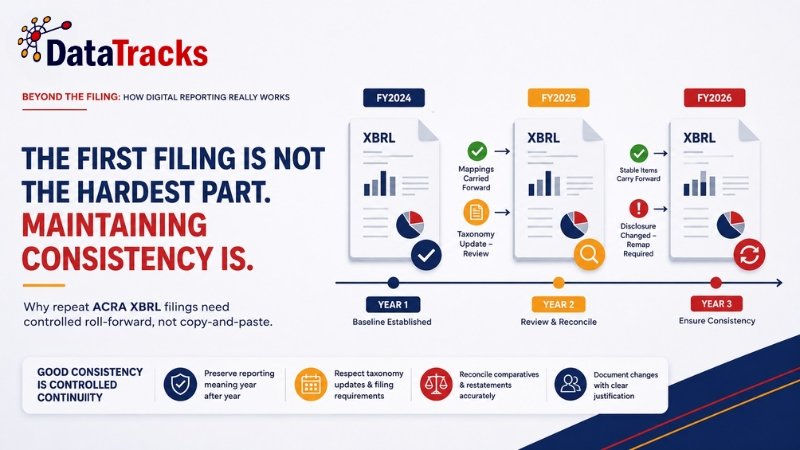
4. Compare against the previous filing – but do not copy blindly
Prior-year mappings provide a useful consistency baseline. Every mapping should nevertheless be reconsidered when disclosures, accounting policies, business activities or taxonomy requirements change.
5. Document the rationale for judgement-based mappings
Maintain a mapping record that explains why a concept was selected, particularly where the financial statement label differs materially from the taxonomy label. This reduces dependence on individual preparers and strengthens future-period review.
Beyond Successful Submission
The difference between digitised and standardised reporting is not academic. It determines whether financial information can be consistently validated, compared and reused.
For XBRL filing in Singapore, the source document remains essential – but it is only the starting point. The ACRA XBRL requirement asks companies to translate the meaning of their financial statements into a defined digital structure.
That translation requires more than software. It requires taxonomy knowledge, accounting interpretation, validation discipline and a clear understanding of how the data will be used after submission.
A capable ACRA XBRL filing process should therefore deliver more than an accepted file. It should produce structured information that remains faithful to the accounts, consistent over time and useful beyond the filing itself.
That is where expertise across mapping, conversion, validation and filing becomes material – not as an additional layer of compliance, but as the means of preserving financial meaning in a machine-readable environment.