ACRA XBRL Filing
EYOND THE FILING | HOW DIGITAL REPORTING REALLY WORKS
ACRA XBRL Filing: Why Passing Validation Does Not Guarantee Filing Quality
For Finance And Compliance Teams Preparing XBRL Filings In Singapore
ACRA XBRL Filing: Why Passing Validation Does Not Guarantee Filing Quality
The BizFinx Preparation Tool shows no unresolved genuine errors. The XBRL file uploads successfully. The annual return can now proceed.
For many finance teams, that sequence feels like proof that the filing is correct.
It is proof of something important: the file has satisfied the applicable checks well enough to move through the submission process. But it does not necessarily prove that every financial statement item has been mapped to the most appropriate taxonomy concept, that each comparative figure has been treated consistently, or that the resulting data will be interpreted correctly when analysed.
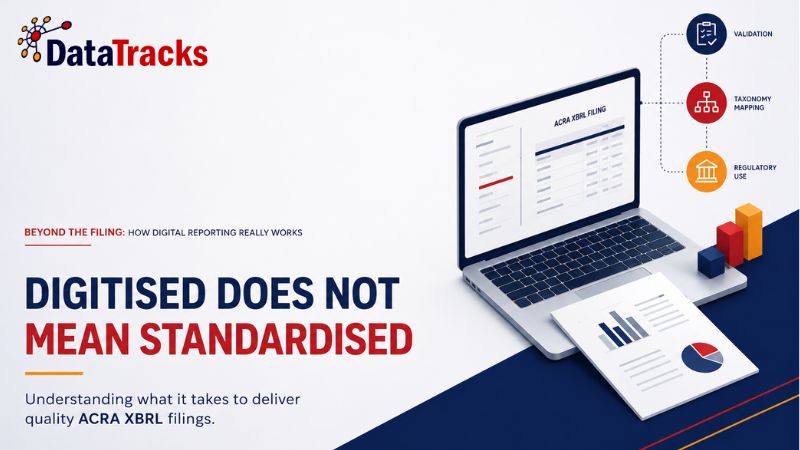
A successful ACRA XBRL filing and a high-quality filing are related. They are not identical.
What Validation Actually Proves
Validation is an essential part of structured reporting. It checks whether an XBRL report complies with defined technical and business rules.
At a technical level, validation can test whether:
- Facts refer to valid taxonomy concepts
- Values use the appropriate data type
- Reporting periods are correctly structured
- Units and currencies are valid
- Dimensional combinations are permitted
- Required information is present
- Defined calculations and business relationships are consistent
The XBRL Regulatory Playbook distinguishes between filing rules, which ensure that a report can be accepted and processed by the submission system, and business validation rules, which test completeness, consistency and defined business logic.
ACRA follows a similar layered approach. Once the BizFinx template has been completed, the Preparation Tool runs validation checks and flags issues. Genuine errors must be corrected or addressed through an exemption where the financial statements themselves are correct. Possible errors must be reviewed, but the preparer may acknowledge them and continue where the reported data is accurate. The authorised user must also confirm that the XBRL data is correct before upload.
These checks prevent many serious errors. They improve consistency, reduce avoidable rejection and provide an important control before filing.
But validation operates against rules that have been defined in advance. It cannot automatically test every judgement that went into preparing the file.
What Validation Cannot Fully Determine
The ACRA taxonomy is a structured dictionary based on Singapore financial-reporting disclosure requirements. It is a closed taxonomy, meaning companies cannot create their own company-specific concepts or relationships. Instead, preparers must map the line items in their financial statements to the most relevant concepts available in the taxonomy.
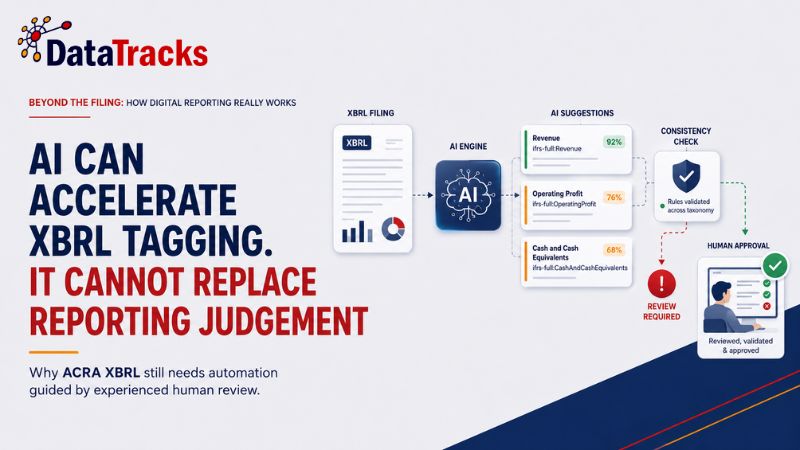
That mapping requires interpretation.
A validation rule can confirm that a monetary value has been assigned to a valid monetary concept. It may also confirm that the value has a valid currency and reporting period. What it may not be able to establish is whether the selected concept is the best accounting representation of the original disclosure.
Suppose a company reports a specialised operating expense. The preparer selects a broad “other expenses” concept that is technically permitted. The value may be correct, the calculation may balance and the file may pass validation.
Yet the mapping could still be weaker than an available, more specific concept.
The filing is technically usable. The data is analytically less precise.
This is why ACRA advises preparers to apply a best-fit principle when matching financial-statement items to the taxonomy and to use “others” only for unique items that cannot be mapped to an available concept. ACRA also recommends involving someone familiar with the financial statements and reviewing the mapping before submission.
How Technically Valid Tagging Can Still Produce Poor Data
1. A Broad Concept Replaces A More Precise One
A preparer may choose a general taxonomy concept because its label appears similar to the wording in the financial statements.
The selected concept may be valid and may not trigger any error. But if the economic meaning is better represented by another concept, users of the structured data receive a less accurate classification.
This matters because XBRL is not simply displaying the number. It is telling systems what the number means.
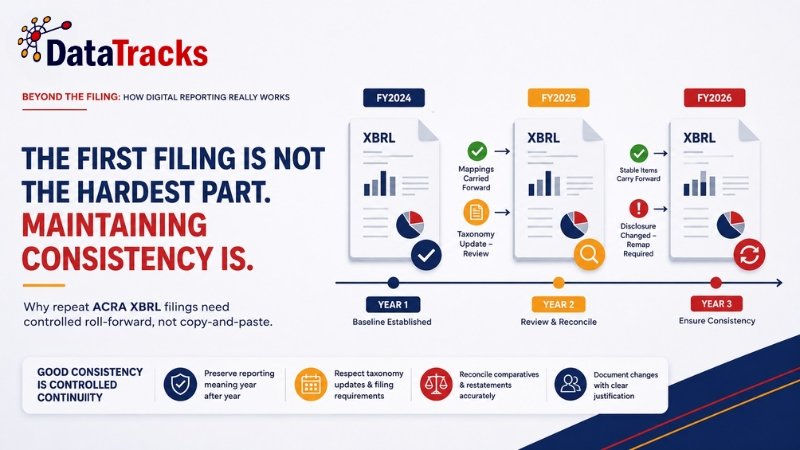
2. The Same Disclosure Is Tagged Differently Between Years
A line item may be mapped to one taxonomy concept in the previous filing and another in the current year, even though the underlying accounting meaning has not changed.
Each filing may pass validation independently. However, a system comparing the two periods could treat the values as different categories rather than a continuous series.
Prior-year data can support efficiency, but it should not be copied without review. ACRA notes that taxonomy changes can prevent some elements from importing correctly and places responsibility on preparers to verify the accuracy and completeness of comparative figures.
3. The Amount Is Correct, But Its Context Is Weak
An XBRL fact consists of more than a value. It also includes metadata such as the reporting entity, period, currency, unit and applicable dimensional breakdown.
A figure may agree with the source financial statements but still be associated with the wrong period, entity scope or reporting context. Some combinations will fail validation. Others may remain technically plausible.
The XBRL Regulatory Playbook identifies concept validity, period consistency, unit specification and dimensional constraints as separate components of XBRL validation because each contributes to the meaning of a reported fact.
4. Several Items Are Combined Without A Clear Mapping Trail
ACRA permits different mapping approaches, including many-to-one mapping, where several financial-statement line items are combined under one taxonomy concept.
This may be entirely appropriate. The risk arises when the preparer does not retain a clear record of which source items make up the reported taxonomy value.
The total can remain correct, and the XBRL file can remain valid. But future preparers may struggle to reproduce the treatment, explain movements or determine whether the same mapping remains appropriate.
5. A Prior-Year Treatment Is Repeated After The Disclosure Changes
Using the previous filing as a starting point is sensible. Treating it as unquestionable authority is not.
A company may change its business activities, accounting presentation, consolidation structure or disclosures. The taxonomy may also be revised. A previous mapping that was once reasonable may no longer reflect the current-year financial statements.
Validation checks the current file against current rules. It does not always explain whether the historical reasoning behind a mapping still holds.
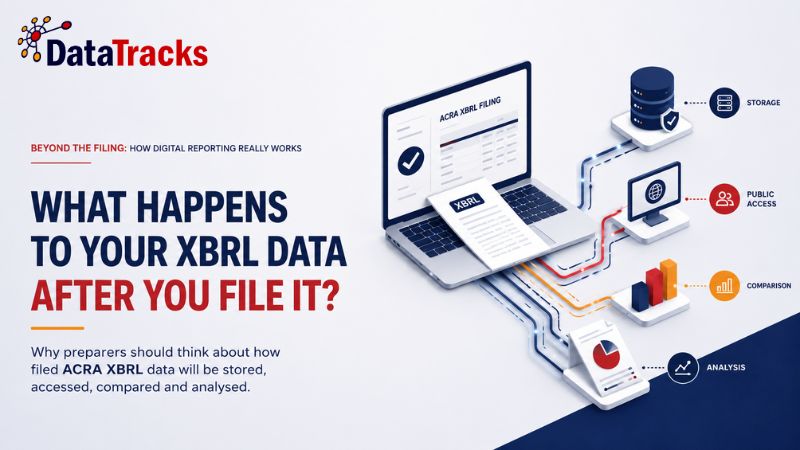
Why Filing Quality Matters After Submission
The immediate objective of an XBRL filing in Singapore is regulatory compliance. But structured financial data has a life beyond successful upload.
ACRA states that financial statements filed as part of annual returns are available for public purchase. XBRL templates capture structured financial information intended to be processed and compared more consistently than an unstructured document.
Poor tagging therefore has consequences beyond the submission screen.
- Inconsistent trend analysis
- Weak comparability between companies
- Misclassification in extracted datasets
- Greater effort during the next filing cycle
- Dependence on individual preparers’ knowledge
- Difficulty explaining mapping decisions during review
- Repetition of historical tagging weaknesses
The XBRL Regulatory Playbook makes an important point: high-quality data is not guaranteed merely because XBRL is used. Quality depends on taxonomy design, the strength of validation rules and the consistency with which reporting entities apply the standard.
The DataTracks Point Of View: Quality Must Be Tested At Three Levels
An effective XBRL conversion service should not define quality solely as “the file passed validation”.
A stronger quality framework considers three distinct questions.
| Quality level | What it tests |
| Source fidelity | Does the XBRL file agree with the financial statements tabled at the AGM or circulated to members? |
| Semantic accuracy | Does each selected taxonomy concept represent the accounting meaning of the source disclosure? |
| Period-to-period consistency | Has the same accounting meaning been represented consistently across periods, except where a disclosure or taxonomy change justifies a different treatment? |
A filing that satisfies all three tests is more likely to remain reliable when reviewed, extracted and compared.
This is the difference between preparing an acceptable submission and preserving the meaning of financial information in structured form.
Six Controls For A Higher-Quality ACRA XBRL Filing
1. Review Mapping Separately From Validation
Do not treat the validation report as a substitute for reviewing taxonomy selection. Perform a dedicated mapping review against the source financial statements.
2. Compare Taxonomy Concepts Across Periods
When reviewing comparative figures, check the concepts and contexts used—not only whether the monetary values agree.
3. Challenge Broad “Other” Classifications
Where a general concept has been selected, confirm that no more specific concept is available and document the basis for the decision.
4. Verify the Complete Fact
Review the concept, value, period, currency, unit and dimensional context together. Accuracy in one component does not compensate for weakness in another.
5. Retain a Mapping Trail
Document how source line items were combined, split or mapped. This is particularly important for many-to-one and judgement-based mappings.
6. Assign Final Accountability
Someone familiar with both the financial statements and the XBRL output should approve the final mapping.
Passing Validation Is The Control Point, Not The Finish Line
Validation is indispensable. Without it, XBRL reporting would be slower, less consistent and more prone to structural errors.
But its role should not be overstated.
Passing BizFinx validation demonstrates that the file has complied with the applicable automated checks or that remaining warnings have been reviewed and acknowledged. It does not remove the need to verify accounting meaning, source fidelity and year-on-year tagging consistency.
A high-quality ACRA XBRL filing therefore requires more than software compliance. It requires financial-reporting knowledge, disciplined taxonomy mapping, contextual review and a clear understanding of how structured data will be interpreted after filing.
That is the standard an experienced ACRA XBRL process should aim for: not merely a file that the system can accept, but data that finance teams, regulators and other users can rely on.