
A Turning Point in Financial Reporting
In April 2024, the International Accounting Standards Board (IASB) announced IFRS 18: Presentation and Disclosure in Financial Statements, a new accounting standard that supersedes the long-standing IAS 1 and represents the most major revision in reporting presentation in years. The major goal is to increase the comparability, uniformity, and transparency of financial statements, particularly income statements, over the world.
IFRS 18 will be necessary for financial years beginning on or after January 1, 2027, with retrospective application, requiring comparative statistics (e.g., FY 2026) to be restated in the new format.
What Is IFRS 18 – and Why Now?
IFRS 18 replaces IAS 1 Presentation of Financial Statements, which has been in effect since 1997. The IASB did not reconsider all aspects of IAS 1 when developing IFRS 18 but instead focused on the statement of profit or loss. While the previous standard achieved its aim, it lacked a vital component: it never clearly defined “operating profit.” This omission provided businesses a lot of leeway in how they framed their income statements, and many took full advantage.
The result? Two companies in the same industry could present vastly different income statements, although being strictly compliant with IFRS, making meaningful comparisons practically difficult. The development of non-GAAP metrics, such as EBITDA, adjusted earnings, and underlying profit, made the picture even murkier.
The IASB spent years engaging with investors, analysts and preparers before deciding on IFRS 18 as a solution. Users of financial statements sent a clear message: we demand organisation, consistency and transparency.
How is IFRS 18 Different from IAS 1?
| Area | IAS 1 | IFRS 18 |
| Income Statement Structure | No mandated structure; entities chose their own layout | Five mandatory categories: Operating, Investing, Financing, Income Taxes, and Discontinued Operations |
| Operating Profit | Not defined or required as a subtotal | Formally defined and mandatory subtotal, consistent across all entities |
| Required Subtotals | No required subtotals | Three mandatory subtotals: Operating profit, Profit before financing & tax, Profit or loss |
| Management Performance Measures (MPMs) | No specific requirements or reconciliation needed | Must be disclosed in the notes with a reconciliation to the nearest IFRS subtotal |
| Disaggregation | Limited guidance on breaking down line items | Detailed requirements to disaggregate items with different characteristics |
| Comparability | High flexibility, lower comparability | Reduced flexibility, significantly higher comparability |
Key Takeaway:
IFRS 18 is simply an IAS 1 rebuilt for comparability. Under IAS 1, corporations had wide flexibility in structuring their income statements and highlighting performance criteria, making it difficult to compare outcomes across organizations. IFRS 18 tightens this by enforcing a consistent income statement structure with defined categories and subtotals, as well as requiring corporations to publicly justify and reconcile any “adjusted” metrics used in investor communications. In short, the move is from freedom to structure – the same data, but much more disciplined in how they are presented.
IFRS 18: A Glimpse of Changes to Come
1. A Structured Income Statement
Perhaps the most noticeable change is the addition of obligatory sections to the profit and loss statement. IFRS 18 requires that all income and expenses fall into one of five categories:
Operating: The primary revenue-generating activities of the firm.
Investing: Returns on assets that are not important to the main business, such as dividends or interest from a manufacturer’s investment portfolio.
Financing costs: are those linked with the company’s financial structure, primarily interest on debt.
Income taxes: can be either an expense or a source of income.
Discontinued operations: The results of firms that have been sold or closed down.
This taxonomy appears simple, yet it has huge implications. Companies will no longer be able to hide volatile elements in ambiguous categories or combine investment returns and operating performance.
2. Two New Mandatory Subtotals
For the first time under IFRS, companies must present two defined subtotals:
Operating profit: A formally defined figure that captures performance from core business activities, stripped of investing and financing items.
Profit before financing and income tax: A broader measure that bridges operating profit with financing costs – useful for assessing a company’s earning power before capital structure decisions.
The formal definition of operating profit is a landmark moment. It gives analysts, investors, and regulators a common reference point – one that is no longer at the mercy of management discretion.
3. Management-Defined Performance Measures (MPMs)
IFRS 18 does not prohibit non-GAAP metrics, but it does shed light on them. Any performance measure communicated publicly by management (such as “adjusted EBITDA” or “underlying earnings”) and generated from IFRS statistics is characterized as a Management-Defined Performance Measure (MPM).
For each MPM, companies must now disclose:
-
- A clear label and description of what the measure represents.
-
- A reconciliation to the most directly comparable IFRS-defined subtotal.
-
- An explanation of why this measure provides useful information to investors.
-
- The tax effect of any adjustments made.
This is a significant step. Companies can continue to promote their preferred metrics, but they must now account for them thoroughly, making it far more difficult to hide poor underlying performance behind pleasing alternate measurements.
4. Enhanced Principles on Aggregation & Disaggregation
IFRS 18 additionally clarifies when line items should be set out separately (disaggregation) or combined (aggregation). The idea is to ensure that neither overly cluttered nor overly simplified statements hide the important information.
The necessity to separately disclose income and expenses that are exceptional in nature or frequency, such as items with limited predictability, low recurrence, or that fall outside the ordinary course of business, is especially notable.
Consider restructuring charges, asset write-downs, and litigation settlements. These can no longer be routinely buried.
Does this apply to you?
IFRS 18 applies to all entities that report under International Financial Reporting Standards. That means enterprises in over 140 countries, including the European Union, the United Kingdom, Canada, Australia, and most of Asia and Africa, will have to adapt.
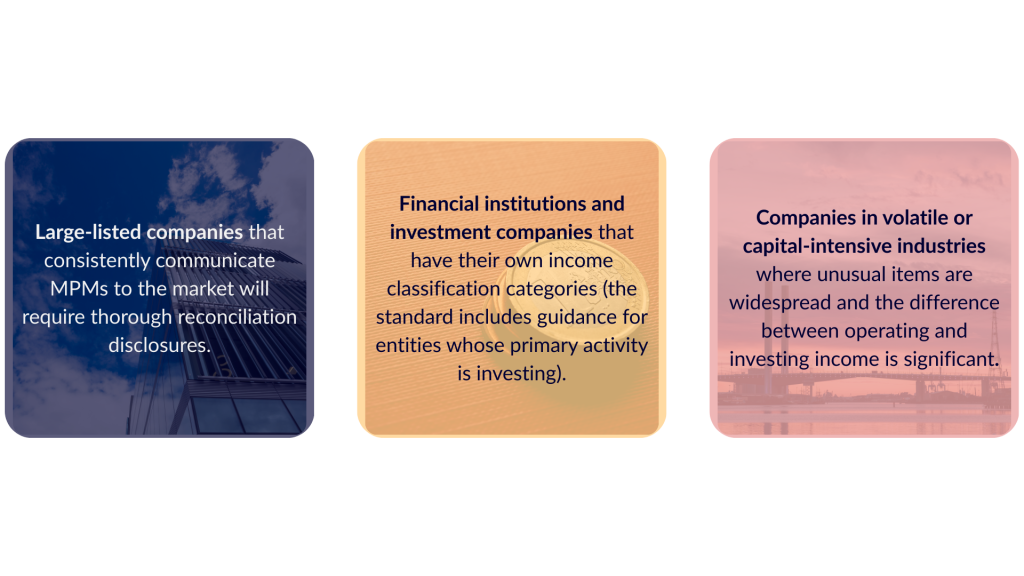
The impact will be felt most acutely by:
The Implications for Preparers
Companies should assess the following:
-
- If current reporting systems classify income/expenses according to IFRS 18 categories.
-
- Determine if additional disclosures, such as MPM reconciliations, are necessary.
-
- How aggregation/disaggregation principles affect current line items.
Early planning can reduce risk while also ensuring compliance by the adoption date.
What This Means for Investors and Analysts
From an investor’s perspective, IFRS 18 is a long-overdue corrective. The new standard will make it significantly easier to:
-
- Compare the operating performance of companies in the same industry on a like-for-like basis.
-
- Determine how much profit a corporation generates from its core operations against its investment portfolio.
-
- Evaluate management’s own performance metrics against a common, audited baseline.
-
- Identify one-time items that businesses may have previously incorporated into recurring figures.
For equity analysts and portfolio managers, the new necessary subtotals, notably defined operating profit, will simplify valuation models and lower the risk of utilising management-inflated estimates.
Effective Date & Adoption Considerations
IFRS 18 applies to annual reporting periods beginning on or after 1 January 2027 and requires retrospective application. Companies will need to:
-
- Restate comparative figures
-
- Update reporting templates and systems
-
- Train finance teams on the new classifications
-
- Reconcile historical subtotals to the new defined ones
Given the scope of changes, preparation well ahead of the effective date is crucial.
In Conclusion
IFRS 18 represents a significant shift in the presentation and disclosure of financial statements, prioritising comparability, clarity, and relevant performance insights. Although the financial facts remain unchanged, the way organisations disclose and interpret those numbers will alter dramatically. Early planning and adoption preparation are critical for fulfilling the 2027 goal effectively.
To hear more from our experts about the shift, write to contact@datatracks.com