NASDAQ LISTING COMPLIANCE
Your stock gets manipulated. Nasdaq delists you anyway. Meet the regulation that has just altered the game. A new Nasdaq rule authorized by the SEC implies that your company may be removed from the exchange even for actions you did not take. The threat isn’t coming from where you’d anticipate, and CFOs who grasp this will be the ones to safeguard their listings.
Every CFO of a small-cap or mid-cap public firm discreetly ignores the following nightmare scenario. Anonymous actors and anonymous social media profiles begin pushing your stock. Trading volume surges. Price moves in mysterious ways. The fundamentals do not explain it. The SEC takes notice. It imposes a ten-day trading suspension under Section 12(k) of the Exchange Act. Even if your company did nothing wrong, fulfills all Nasdaq financial metrics, has current filings, and has clean management, Nasdaq will nonetheless delist your shares.
This is no longer a hypothetical. On June 3, 2026, the SEC gave Nasdaq Rule IM-5101-4 expedited approval (Release No. 34-105603). The rule is already in place, and it profoundly alters the compliance equation for any public business with a thin float, a concentrated ownership structure, or any other feature that makes a stock appealing to manipulators.
If you are a CFO, Chief Compliance Officer, General Counsel, or Director of Accounting for a publicly traded firm, this is the rule you didn’t realize you needed to read – and you should read it now.
The Threat Is Not Who You Expected
The temptation in public business compliance is to portray the regulator as an adversary – the SEC comment letter, the enforcement action, the EDGAR review, and the Nasdaq deficiency notice. Compliance programs are designed to manage that interaction.
Nasdaq Rule IM-5101-4 creates a fundamentally new threat: the anonymous third party.
Since September 2025, the SEC has imposed Section 12(k) trading suspensions on over a dozen publicly traded companies, including Smart Digital Group, QMMM Holding, Etoiles Capital Group, Platinum Analytics Cayman, Pitanium, Empro Group, NusaTrip, Premium Catering Holdings, Robot Consulting, Charming Medical, Magnitude International, JM Group, and TechCreate Group. The trend in each case was consistent.
- Anonymous actors operating through social media platforms
- Coordinated promotions encouraging regular investors to purchase, hold, or sell.
- Artificially inflated prices and trading volumes.
- The SEC suspended trading in the public interest.
In none of these cases did the listed firm itself orchestrate the deal. These companies were the victims of manipulation, not the creators of it. However, their stocks were suspended. According to the new rule, they can now be delisted.
This is the threat that current compliance programs were not intended to combat. That is precisely why it requires the attention of financial executives.
What the Rule Actually Requires
Nasdaq Rule IM-5101-4, effective June 3, 2026, provides Nasdaq official, codified authority to delist a listed security under two conditions:
- When the SEC believes that continued trading threatens investor protection or the public interest, it issues a Section 12(k) suspension, which is a temporary trading halt lasting up to 10 working days.
- Nasdaq evaluates whether delisting is necessary to protect investors on a case-by-case basis using predefined criteria.
The rule applies even if the firm and its management have operated totally in good faith and the company meets all other Nasdaq listing standards at the time of the finding.
Nasdaq’s explanation is structural, not punitive. They believe that if a stock can be affected by anonymous social media users, it has the float depth, investor base, and liquidity required for a fair and orderly market. The listing no longer serves its intended purpose, regardless of who created the disruption.
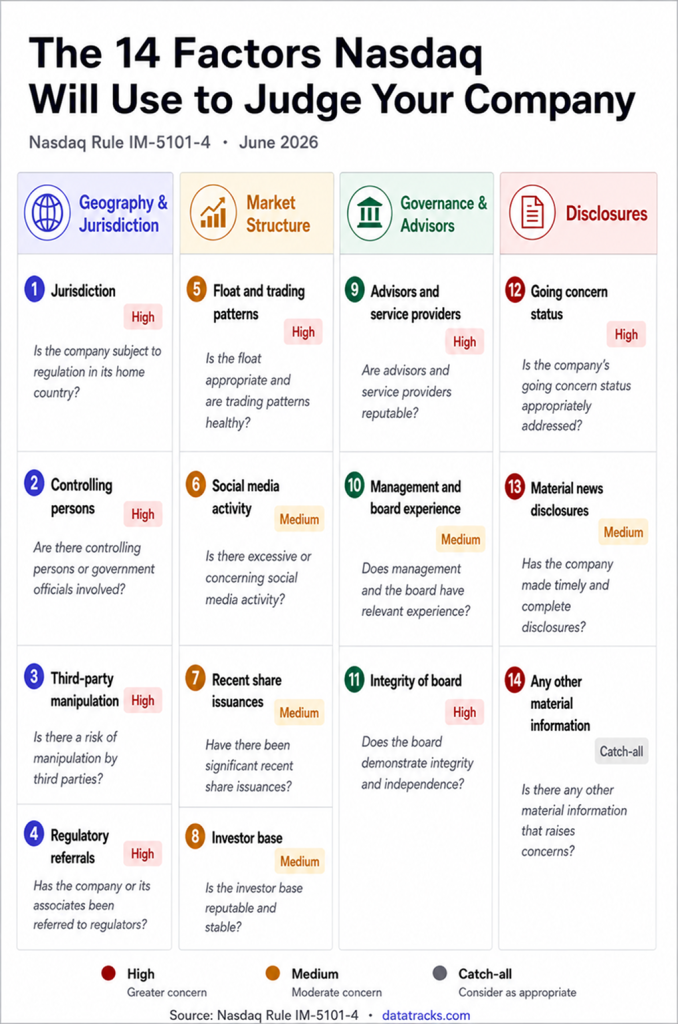
The 14 Factors Nasdaq Will Use to Evaluate Your Company
This is the section that every compliance team should document and map against. Nasdaq will consider all relevant facts and circumstances before initiating delisting proceedings. For a complete list of specified considerations, compliance teams should refer to Rule IM-5101-4 in its entirety.
Examine those factors carefully. Most have nothing to do with your financial performance. They focus on your governance structure, disclosure policies, adviser ties, and trading profile. These are compliance and reporting questions, not just financial ones.
The Proactive CFO’s Action Plan
This is where the narrative turns in your favor. The anonymous manipulation cannot be completely controlled. However, the conditions that make your company vulnerable to it – and the conditions that influence how Nasdaq judges you after a suspension – are almost entirely under your control.
CFOs who safeguard their listings in this context are those who view listing compliance as a continual, active program rather than a passive outcome of satisfying financial requirements.
1. Monitor Your Trading Data, Not Just Your Books
Unusual trading patterns are evident before the SEC takes action. If your stock is experiencing unexplained volume spikes, price fluctuations that do not correspond to your news cycle, or unaccounted-for social media activity, the time to contact Nasdaq is before a Section 12(k) suspension, not after. The rule clearly allows Nasdaq to request extra information from a business, which might be used to justify a trading halt or, alternatively, a decision not to delist.
Companies that actively document their investor base, float distribution, and trading patterns are considerably better positioned to provide the data Nasdaq requires to rule in their favor.
2. Make Your Disclosure Posture Unassailable
The rule expressly assesses whether your material news disclosures adequately explain the observed trading activity. This is a direct measure of disclosure quality and timeliness – not just technical SEC compliance, but whether investors and regulators who read your filings can easily understand what is going on in your company.
That standard begins with your SEC filing infrastructure. If your 10-K, 10-Q, and 8-K filings are difficult to navigate, inconsistently tagged, take a long time to show on your investor relations page, or contain inaccurate data, you are already failing Nasdaq’s transparency standards. Poor disclosure hygiene is one of the most common – and avoidable – compliance issues confronting publicly traded organizations. It is also among the easiest to repair.
Maintaining a current, accessible investor relations webpage is a listed company’s key transparency duty if it wants investors and regulators to be able to find, understand, and trust its disclosures.
3. Vet Your Advisors’ Regulatory History
Nasdaq will investigate your auditors, underwriters, legal counsel, brokers, and clearing businesses. It will determine whether they were subject to regulatory review and what the outcomes were. It will look at whether their principals were previously associated with firms with questionable trading histories.
This is a due diligence concern that most public firms have never officially addressed. Building a documented adviser review file and updating it annually is no longer a hypothetical exercise, but rather a sound governance practice.
4. Keep Insider Reporting Current and Accurate
Nasdaq will evaluate the integrity of your board, management, and major shareholders. Insider ownership is disclosed to authorities and investors through Section 16 filings (Forms 3, 4, and 5). Late, inaccurate, or missing Section 16 disclosures are precisely the types of governance flaws that Rule IM-5101-4 seeks to address. Keeping insider filings accurate and on time is one of the most obvious signs of a well-managed publicly traded corporation.
5. Know Your Appeal Rights Before You Need Them
The regulation establishes a systematic process. If Nasdaq issues a Staff Delisting Determination under Rule 5810(c)(1), the corporation may request review under Nasdaq Rule 5815. Understanding this appeal pathway—and being prepared to offer proof of sufficient float, investor base, and market interest—is contingency planning that every legal and compliance team should undertake before it is required.
The Broader Compliance Context in 2026
The timing of Nasdaq Rule IM-5101-4 is not a coincidence. It comes alongside the SEC’s semi-annual reporting plan (Release No. 33-11414). Both rules reflect the same regulatory direction: the criteria for what it means to be a public corporation in the United States are rising, and this is happening on numerous fronts at the same time.
The semi-annual reporting proposal reduces filing frequency while boosting the weight and disclosure intensity of individual filings. The Nasdaq delisting regulation provides a new level of listing risk that is completely outside of standard financial compliance frameworks. Together, they describe a 2026 climate in which the quality, integrity, and accessibility of your disclosures have never been more important.
Where DataTracks Fits In
The compliance architecture that protects you from anonymous manipulation, regulatory scrutiny, and a Nasdaq delisting decision is based on a single premise: disclosure accuracy and integrity throughout the filing process.
DataTracks Rainbow™ is the platform that makes this possible. DataTracks Rainbow™, designed for corporations filing with the SEC, supports iXBRL tagging, multi-user collaborative review, EDGAR-direct submission, and a structured workflow to ensure that every disclosure is accurate, validated, and submitted on time. When Nasdaq determines whether your material disclosures adequately explain observed trading activity, it starts with the integrity of your filing system.
For organizations managing insider reporting duties, DataTracks Section 16 filing services ensure Forms 3, 4, and 5 are correctly created and sent to EDGAR on time, keeping a clean governance record for the type of regulatory scrutiny Rule IM-5101-4 currently allows.
The threat in this scenario lurks in the shadows of your trading history. The defense is based on the clarity of your disclosures. Make sure yours is ready.
Key Takeaways for CFOs and Compliance Leaders
- Nasdaq Rule IM-5101-4 is effective as of June 3, 2026. Companies can be delisted after an SEC trading suspension, even if the issuer has done nothing wrong.
- Nasdaq’s 14 evaluation factors will overwhelmingly focus on governance, disclosure, and advisor-quality questions, rather than financial measurements.
- Your major safeguards include proactive monitoring of trading patterns, clean insider reporting, high-quality SEC reports, and documented adviser due diligence.
- While the opportunity to appeal under Rule 5815 is present, meaningful protection is created during the planning period before a determination is given.
- The combination of Nasdaq Rule IM-5101-4 and the SEC’s semi-annual reporting proposal establishes a new compliance baseline for listed companies in 2026.