DATATRACKS SINGAPORE
DEFINITIVE GUIDE • UPDATED APRIL 2026
XBRL Filing in Singapore
The Complete 2026 Guide
Requirements • Deadlines • Formats • Step-by-Step Process • Penalties • Expert Tips
Key Takeaways
- Mandatory since 1 Nov 2007 — XBRL filing applies to all Singapore-incorporated companies limited or unlimited by shares, with limited exemptions.
- Listed companies: 5 months after financial year end; non-listed: 7 months.
- Four formats: Full XBRL, Simplified XBRL, XBRL FSH for Banks, XBRL FSH for Insurance.
- Late filing penalties: S$300–S$500 per offence. Directors risk disqualification for repeat offences.
- Solvent Exempt Private Companies (EPCs) and dormant companies may qualify for exemptions.
- The free BizFinx tool from ACRA is used to prepare XBRL files before submission via BizFile+.
- DataTracks offers end-to-end XBRL conversion and filing with a 100% ACRA acceptance rate.
XBRL Filing in Singapore
1. What Is XBRL Filing in Singapore?
XBRL — eXtensible Business Reporting Language — is an open, global standard for the electronic communication of business and financial data. In Singapore, XBRL filing refers to the mandatory process by which companies submit machine-readable financial statements to the Accounting and Corporate Regulatory Authority (ACRA) through the BizFile+ portal.
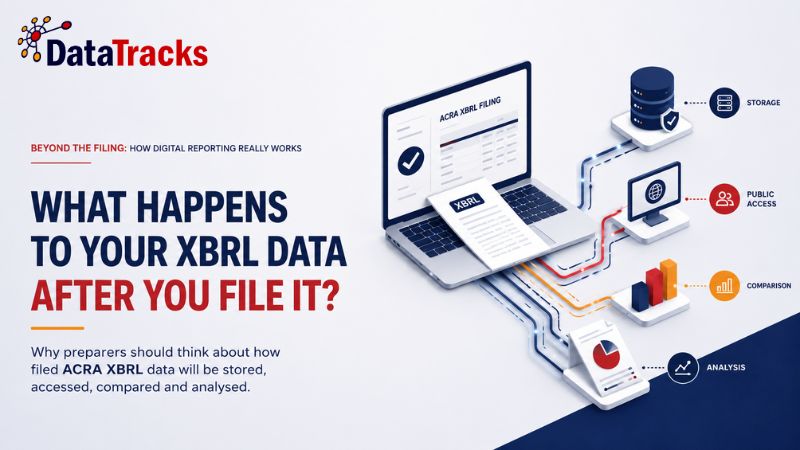
Unlike a traditional PDF or Word-document submission, XBRL tags every line item in a financial statement — revenue, net profit, total assets, liabilities — with a unique, standardised identifier drawn from the ACRA Taxonomy. This allows regulators, investors, auditors, and analysts to extract, compare, and analyse financial data automatically across thousands of companies, without manual re-keying.
Singapore was among the first jurisdictions in Asia to mandate XBRL for corporate filings, with ACRA introducing the requirement on 1 November 2007. Since then, the framework has been updated multiple times to align with international standards and to reflect Singapore Financial Reporting Standards (SFRS and SFRS for Small Entities).
Regulatory Purpose Enables ACRA, MAS, and other regulators to monitor Singapore’s corporate sector in real time and identify risk trends. | Investor Transparency Makes financial data instantly comparable across industries, reducing information asymmetry for shareholders and creditors. |
Operational Efficiency Eliminates manual data extraction from PDFs, reducing compliance costs for regulators and automating downstream analytics. | Global Standard XBRL is used by 50+ regulators globally — including the SEC (USA), FCA (UK), and ESMA (EU) — making Singapore’s data internationally compatible. |
“XBRL is not merely a filing format — it is the infrastructure of financial transparency. Companies that embrace it as a strategic asset rather than a compliance burden gain a measurable reporting advantage.”
— DataTracks XBRL Advisory Team, Singapore
2. Who Must File Financial Statements in XBRL Format?
The requirement to file financial statements in XBRL format with ACRA applies to all companies incorporated in Singapore that are limited or unlimited by shares, unless a specific exemption applies. This includes:
- Singapore-incorporated private limited companies (Pte. Ltd.) — listed and non-listed
- Public companies limited by shares
- Subsidiary companies of foreign multinationals incorporated locally in Singapore
- Companies limited by guarantee that prepare accounts under SFRS
- Investment holding companies and group entities
Foreign Branch Offices vs. Local Subsidiaries
Foreign companies operating in Singapore as branch offices (not locally incorporated) file their home-country financials and are generally not required to submit in XBRL format. However, locally incorporated subsidiaries of foreign parent companies must comply fully with ACRA’s XBRL requirements.
3. Who Is Exempt from XBRL Filing Requirements?
ACRA provides targeted exemptions for specific categories of companies where the compliance burden would be disproportionate to the regulatory benefit.
3.1 Solvent Exempt Private Companies (EPCs)
An Exempt Private Company (EPC) is one with 20 or fewer shareholders, none of which is a corporation. Solvent EPCs that can meet their debts as they fall due may be exempt from filing audited financial statements with ACRA and, by extension, from XBRL requirements, provided they meet the criteria under Section 201A of the Companies Act.
3.2 Dormant Companies
A dormant company — one that has had no accounting transactions during the financial year — qualifies for an exemption from filing financial statements. Since there are no financial transactions to report, XBRL filing is not required. The company must still file an Annual Return with ACRA.
3.3 Companies Using Alternative FSH Templates
Banks, insurance companies, and certain regulated entities use specialised XBRL FSH (Financial Statement Highlights) templates rather than Full or Simplified XBRL. These institutions are not exempt from XBRL, but file under a different template tailored to their sector-specific regulatory reporting requirements.
3.4 Companies Not Required to Prepare Audited Accounts
Companies qualifying to dispense with an audit (under Sections 205B or 205C of the Companies Act) and meeting the small company criteria may also be exempt from XBRL filing requirements.
Warning: Do Not Assume Exemption — Verify
Directors are personally responsible for ensuring their company meets exemption criteria. Incorrectly assuming an exemption and failing to file is treated as a filing offence under the Companies Act, with penalties applying to both the company and its directors.
Got doubts?
4. Which Financial Statements Must Be Filed in XBRL Format?
ACRA mandates that the following core financial statements be prepared and submitted in XBRL format as part of a company’s Annual Return filing:
Balance Sheet Assets, liabilities, and equity as at the financial year end. | Income Statement Revenue, expenses, and profit or loss for the financial year. | Cash Flow Statement Inflows and outflows: operating, investing, and financing activities. | Changes in Equity Movements in share capital, retained earnings, and reserves. |
For Full XBRL submissions, selected notes to the financial statements must also be tagged, including disclosures on accounting policies, related-party transactions, and key financial metrics. For Simplified XBRL, a full PDF set of financial statements accompanies the partial XBRL data.
5. XBRL Filing Deadlines in Singapore for 2026
The XBRL filing deadline in Singapore is tied to a company’s Annual Return (AR) filing obligation. XBRL financial statements are filed as part of, or alongside, the Annual Return.
| Company Type | Deadline After FYE | Notes |
| Listed Companies (SGX Main Board & Catalist) | 5 months | Within 4 months of FYE for AGM |
| Non-Listed Companies (with AGM) | 7 months | Within 6 months of FYE for AGM |
| Non-Listed Private Companies (no AGM required) | 7 months | No AGM required |
Applying for an Extension of Time (EOT)
Companies that require additional time can apply for an Extension of Time via ACRA’s BizFile+ portal:
| 1 | Log into BizFile+ Navigate to eServices → Filing of Annual Return → Extension of Time. |
| 2 | Select “Extension of Time” Application Choose the relevant filing period and provide the reason for the extension request. |
| 3 | Pay the Application Fee An administrative fee applies. Amounts vary based on company type and length of extension requested. |
| 4 | Await ACRA’s Decision Processing typically takes up to 14 working days. Apply well in advance of the original deadline. |
6. XBRL Filing Formats in Singapore
ACRA prescribes four distinct XBRL filing formats, each designed for different types of companies and industries. Choosing the wrong format is a common error that leads to rejection.
| Format | Who Uses It | Data Elements | PDF Required? | Listing Status |
| Full XBRL | Listed & large non-listed companies | ~210 elements (primary + notes) | Optional | Listed / Large |
| Simplified XBRL | Smaller non-publicly accountable co. | ~120 elements (highlights only) | Mandatory | Non-listed |
| XBRL FSH for Banks | Banks & financial institutions | ~80 elements | Yes | Regulated |
| XBRL FSH for Insurance | Licensed insurance companies | ~80 elements | Yes | Regulated |
Need Help With XBRL?
7. Full XBRL vs Simplified XBRL: Which Applies to You?
7.1 Full XBRL
Full XBRL tags approximately 210 data elements, including primary financial statements and selected disclosure notes. It is mandatory for:
- All companies listed on SGX Main Board and Catalist
- Large non-listed companies (those that do not qualify as small companies under the Companies Act)
- Companies that are publicly accountable (hold assets in a fiduciary capacity for a broad group of outsiders)
Full XBRL requires companies to:
- Map every line item in primary financial statements to the ACRA Taxonomy
- Tag selected notes: significant accounting policies, property/plant/equipment breakdowns, related-party disclosures
- Validate the XBRL instance document using ACRA’s BizFinx tool before submission
7.2 Simplified XBRL
Simplified XBRL covers approximately 120 data elements — financial statement highlights only — and is designed for smaller, non-publicly accountable companies. A full PDF of the financial statements must accompany the submission.
A company qualifies for Simplified XBRL if it meets the small company criteria under the Companies Act (any two of three thresholds): annual revenue ≤ S$10 million, total assets ≤ S$10 million, ≤ 50 employees, and is not publicly accountable.
DataTracks Tip: Check Your Thresholds Annually
Company size classifications are assessed annually. If your company has grown and crossed the small company thresholds in the current financial year, you may be required to switch from Simplified XBRL to Full XBRL for your next filing. Missing this transition is one of the most common compliance errors we see.
8. Step-by-Step XBRL Filing Process in Singapore
The XBRL filing process involves two major phases: preparation (converting financial statements into XBRL format) and submission (uploading via ACRA’s BizFile+ portal).
| 1 | Finalise Your Financial Statements Ensure your financial statements are complete, audited (if required), and board-approved. Errors in source financials propagate into XBRL data. |
| 2 | Identify Your Filing Format Determine whether your company must file Full XBRL, Simplified XBRL, or a sector-specific FSH template, based on listing status, size, and industry. |
| 3 | Download the BizFinx Preparation Tool Download the free BizFinx desktop application from ACRA’s website. It contains XBRL templates for all filing formats and the Singapore Taxonomy. |
| 4 | Map Financial Data to ACRA Taxonomy Open the appropriate template in BizFinx and map each line item to the corresponding XBRL concept in the ACRA Taxonomy. This is the most technically demanding step. |
| 5 | Enter Data and Validate Enter financial figures and run BizFinx validation to check for errors, missing mandatory fields, and arithmetic inconsistencies. Resolve all warnings before proceeding. |
| 6 | Generate the XBRL Instance Document Export the validated data as an XBRL instance document (file extension: .xbrl). This is the file submitted to ACRA. |
| 7 | Log into BizFile+ and Submit via FS Manager Upload your XBRL instance document alongside required PDFs using the FS Manager. Complete the Annual Return filing at the same time. |
| 8 | Receive Confirmation and Retain Records Retain a copy of the XBRL instance document, validation reports, and submission confirmation for at least five years. |
9. The BizFinx Preparation Tool: A Closer Look
BizFinx is ACRA’s free, downloadable desktop application for preparing XBRL financial statements. It is the primary tool used by companies and their agents to convert financial data into XBRL format before submission to BizFile+.
Built-in Templates Pre-loaded templates for Full XBRL, Simplified XBRL, FSH for Banks, and FSH for Insurance — all aligned with the latest ACRA Taxonomy. | Validation Engine Checks for mandatory fields, arithmetic consistency, and taxonomy compliance before submission, reducing rejection rates. |
Import & Export Allows import of prior-year data and export of the final XBRL instance document for submission. | Free to Download Available at no cost from ACRA’s official website. Regular updates reflect taxonomy changes and regulatory updates. |
BizFinx Has Limitations
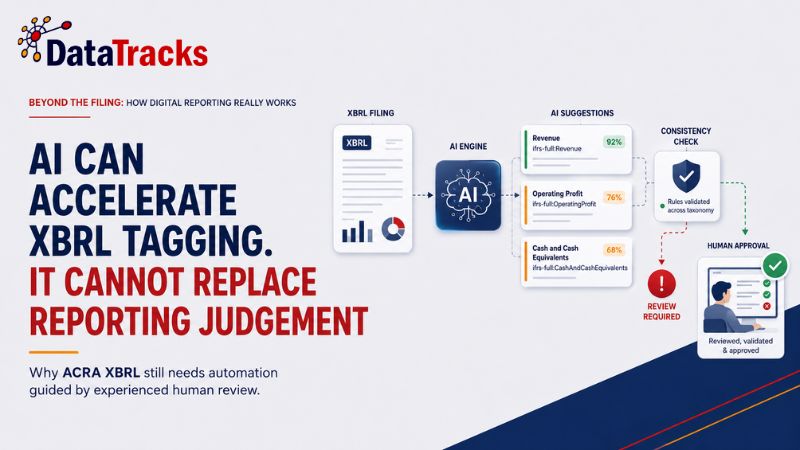
BizFinx is a manual, form-filling tool. For companies with complex financial structures, multiple subsidiaries, or non-standard line items, the taxonomy mapping process can be time-consuming and error-prone. Professional XBRL conversion services like DataTracks automate this process, significantly reducing error rates and preparation time.
10. Understanding the ACRA Taxonomy
The ACRA Taxonomy is the dictionary of XBRL concepts (tags) used in Singapore’s XBRL filing framework. It defines every possible data element — from “Revenue” and “Profit Before Tax” to sector-specific items — that can appear in an XBRL financial statement filed with ACRA.
Key components of the ACRA Taxonomy include:
- Elements: Individual data points (e.g., ifrs-full:Revenue)
- Labels: Human-readable names for each element
- Data Types: Defines whether a value is monetary, textual, boolean, etc.
- Linkbases: Define relationships between elements (calculation, definition, presentation)
- Extension Taxonomy: Companies can create custom elements for items not covered in the base taxonomy, subject to ACRA guidelines
Correct taxonomy mapping is the most technically demanding aspect of XBRL preparation. A mismatch between a financial line item and its taxonomy element can cause validation errors or, worse, result in materially misleading data being filed with ACRA.
Need Help With XBRL?
11. iXBRL: The Future of XBRL in Singapore
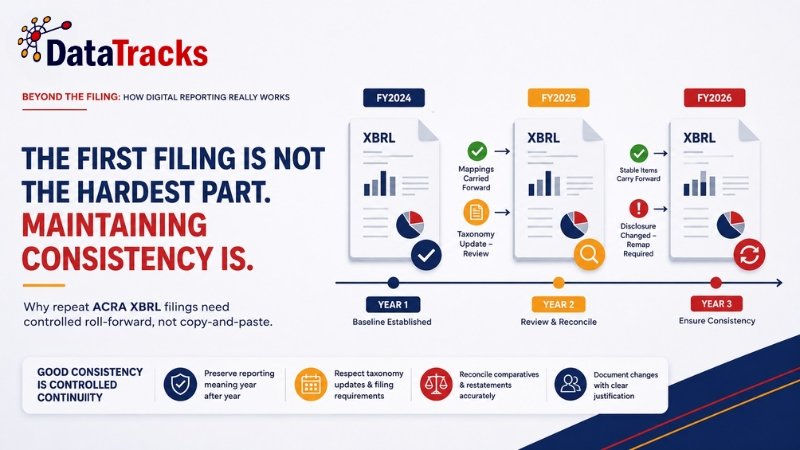
iXBRL (Inline XBRL) is an evolution of traditional XBRL that embeds XBRL tags directly within a human-readable HTML document. The same file is simultaneously a formatted, readable annual report and a machine-readable XBRL data feed — no need to maintain two separate documents.
iXBRL has already been adopted by major regulators globally:
- The US SEC mandated iXBRL for all public company filings from 2020
- The UK’s FCA and HMRC require iXBRL for corporate tax returns
- The European Single Electronic Format (ESEF) requires iXBRL for all EU-listed annual reports
While ACRA’s current primary filing format uses traditional XBRL via BizFinx, Singapore’s regulatory landscape is monitoring global trends closely. DataTracks has full iXBRL capabilities and recommends that Singapore companies — particularly SGX-listed companies and those with international investor bases — begin familiarising themselves with iXBRL workflows now.
12. Penalties for XBRL Non-Compliance in Singapore
Failure to file financial statements in XBRL format constitutes a filing offence under Section 197 of the Companies Act. Penalties are imposed on both the company and its directors.
S$300 Minimum late filing penalty per offence | S$500 Maximum late filing penalty per offence | Director Disqualification Risk for 3+ offences within 5 years |
In addition to financial penalties, persistent non-compliance can lead to:
- Regulatory scrutiny and increased audit risk from ACRA
- Difficulty in banking relationships (banks may flag non-compliant companies)
- Reputational damage — ACRA’s enforcement actions are publicly visible
- Potential disqualification of directors from serving in any Singapore company for up to 5 years
13. Common XBRL Filing Mistakes (and How to Avoid Them)
Based on DataTracks’ experience handling thousands of Singapore XBRL filings, these are the most frequent errors companies make:
| 1 | Using the Wrong Filing Format Filing Simplified XBRL when Full XBRL is required — typically because the company crossed the small company thresholds. ACRA will reject the submission. |
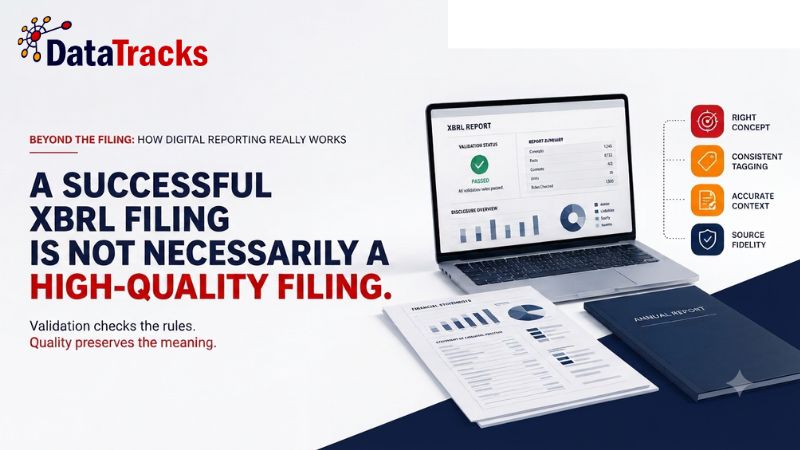
| 2 | Incorrect Taxonomy Mapping Mapping “Revenue” to a gross profit element, or using a parent element where a child is required. This produces technically valid XBRL that contains misleading data. |
| 3 | Missing Mandatory Notes (Full XBRL) Full XBRL requires certain notes to be tagged. Companies often focus only on primary statements and omit required note disclosures, causing validation failures. |
| 4 | Arithmetic Inconsistencies XBRL has built-in calculation rules. If tagged values do not add up (e.g., current + non-current assets ≠ total assets), BizFinx flags validation errors. |
| 5 | No PDF Attached (Simplified XBRL) Simplified XBRL submissions must be accompanied by a full PDF of the financial statements. Submitting XBRL data alone is an incomplete filing. |
| 6 | Outdated BizFinx or Taxonomy Version Filing with an outdated version may cause submission errors or result in filing against deprecated element definitions. |
14. Why Singapore Companies Choose DataTracks for XBRL
DataTracks is Asia’s most experienced XBRL filing specialist, with over 20 years of XBRL expertise, more than 500,000 reports filed globally, and a dedicated Singapore desk serving listed and non-listed companies across every industry.
End-to-End XBRL Conversion Our specialists handle the entire taxonomy mapping and tagging process — from your trial balance to a validated, submission-ready XBRL instance document. | 48-Hour Turnaround Express filing service available for urgent submissions. Standard turnaround is 2–3 business days. |
100% ACRA Acceptance Rate Our rigorous quality control and deep taxonomy expertise means your filing is accepted by ACRA the first time — every time. | Works With Any Format We accept financials in Excel, Word, PDF, or ERP exports. No reformatting required on your end. |
Confidential & Secure Enterprise-grade data security. Your financial data is handled under strict NDA and ISO-compliant processes. | SGX Listed Company Specialists Deep expertise in Full XBRL for SGX-listed companies, including complex consolidated group structures and multi-currency filings. |
“We switched to DataTracks after two years of internal XBRL preparation that consistently resulted in last-minute validation errors. Their team got our Full XBRL filing done in under 48 hours with zero ACRA queries. We haven’t looked back.”
— Finance Director, SGX-listed Singapore company
Need Help With XBRL?
15. Frequently Asked Questions: XBRL Filing Singapore 2026
What is XBRL filing in Singapore?
XBRL (eXtensible Business Reporting Language) filing is the mandatory process by which Singapore-incorporated companies submit structured, machine-readable financial statements to ACRA via the BizFile+ portal. Every financial data point is tagged with a unique identifier from the ACRA Taxonomy, enabling automated analysis and comparison. ACRA has required XBRL filing since 1 November 2007.
Is XBRL filing compulsory in 2026?
Yes. XBRL filing remains compulsory in 2026 for all Singapore-incorporated companies limited or unlimited by shares, unless they qualify for a specific exemption (dormant company or solvent Exempt Private Company). There have been no changes to the core mandate in 2026.
What is the XBRL filing deadline for 2026?
Listed companies: within 5 months after the end of the financial year. Non-listed companies: within 7 months after the end of the financial year. Late filing without an approved extension attracts penalties of S$300–S$500.
What is the difference between Full XBRL and Simplified XBRL?
Full XBRL tags approximately 210 data elements including primary financial statements and selected notes. It is mandatory for listed companies and large non-listed companies. Simplified XBRL tags approximately 120 data elements (highlights only) and requires a full PDF of financial statements to accompany the submission. It is available for smaller, non-publicly accountable companies.
What happens if a company fails to file XBRL with ACRA?
Failing to file XBRL is a filing offence under Section 197 of the Companies Act. Penalties include late filing fees of S$300–S$500 per offence, director disqualification risk for three or more offences within five years, increased regulatory scrutiny from ACRA, and reputational damage.
Do foreign companies in Singapore need to file XBRL?
Branch offices of foreign companies generally file their home-country accounts and are not required to submit XBRL. However, locally incorporated subsidiaries of foreign parent companies are fully subject to ACRA’s XBRL requirements.
What is BizFinx and do I need it?
BizFinx is a free desktop tool provided by ACRA for preparing XBRL financial statements. It contains templates and the taxonomy for all four filing formats. If you outsource your XBRL filing to a specialist like DataTracks, you do not need to use BizFinx yourself.
Can I do XBRL filing myself?
You can file using BizFinx. However, for companies with complex financials or listed status, errors in taxonomy mapping are common. Most Singapore CFOs choose to outsource to specialists like DataTracks to reduce error risk, save time, and ensure first-time ACRA acceptance.
Does DataTracks handle XBRL for SGX-listed companies?
Yes. DataTracks has extensive experience with Full XBRL filings for SGX Main Board and Catalist-listed companies, including complex consolidated group structures, multi-currency translations, and non-standard disclosure notes.
Ready to Simplify Your XBRL Filing?
Get a free quote from DataTracks Singapore — Asia’s most experienced XBRL specialists.